 An ambitious first novel, this is an odd but engaging tale told with the black humor typical of Russian literature. Sasha Goldberg, a black, Jewish Russian girl (!) from the town of Asbestos 2(!!) goes in search of the father that abandoned her and her self-possessed mother when she was a small child. The long road takes her from the weird post-Soviet Russia to being a mail-order bride in Arizona to being the pet Soviet refusenik of a wealthy philanthropic couple in Chicago. It is a sprawling piece of work that never loses a certain tension but can also provide a good laugh and a hard look at how people cope.
Thursday, February 01, 2007
Petropolis by Anya Ulinich
An ambitious first novel, this is an odd but engaging tale told with the black humor typical of Russian literature. Sasha Goldberg, a black, Jewish Russian girl (!) from the town of Asbestos 2(!!) goes in search of the father that abandoned her and her self-possessed mother when she was a small child. The long road takes her from the weird post-Soviet Russia to being a mail-order bride in Arizona to being the pet Soviet refusenik of a wealthy philanthropic couple in Chicago. It is a sprawling piece of work that never loses a certain tension but can also provide a good laugh and a hard look at how people cope.


A Three Dog Life by Abigail Thomas
 A beautifully written memoir. Thomas’ husband, Rich, was hit by a car and suffered traumatic brain injury. After surgeries, etc., his condition became such that Thomas couldn’t care for him at home and placed him in a long-term facility. The book is less about Rich’s troubles as it is about Thomas adjusting to a life on her own, an unexpected turn of events for a couple who married late in life. She still visits Rich. She even moves upstate to be near him and the hospital but Rich is not the same and never will be and Thomas has to learn to live her life without him. At times heartbreaking and other times laugh-out-loud funny, this book can be devoured in one sitting. Eat up.
Paula Spencer by Roddy Doyle
 It’s been 12 years since Doyle introduced us to Paula as The Woman Who Walked Into Doors, a battered wife and mother struggling with alcoholism. At the time, Doyle said he’d like to revisit her at some point in the future to see how she was doing. Here we are. When we left Paula, she was hiding her gin in the garden shed and tossing the key out in the yard to make it difficult for herself to drink. Unlike his last two books, sweeping novels both, Doyle instead keeps this story small. At this point, Paula is making a life for herself, a life she never thought she could actually live soberly. These small victories—holding down a job, saving money, being a responsible adult, at last—are all new to her and something to help measure her life. She’s also dealing with the guilt of raising her kids while drunk. I’m glad Doyle wanted to write about Paula. I’m so happy to see her again.
Tuesday, January 09, 2007
A Spot of Bother by Mark Haddon
 Think your family is a train wreck? Get a load of the Halls. George, a distant father, husband and colleague, is newly retired and suddenly consumed by his own mortality when he finds a “lesion” on his hip that he is convinced is cancer (it’s hardly that) and begins to come unglued. His wife, Jean, is carrying on with George’s former co-worker, the smoothie David Symmonds. Daughter Katie has already gone through a bad marriage and is now engaged to Ray, a good guy who loves her and her son, Jacob, but the Halls disapprove because they deem him too ordinary for their smarter, French-speaking daughter. She might be marrying Ray and she might not; either way, she’s a mess. Son Jamie is involved with Tony but is self-involved enough that the relationship is really more an on-going play date than a real relationship. While a very different book from his brilliant debut, The Curious Incident of the Dog in the Nighttime¸ Haddon maintains a similar light touch as this family careens out of control while learning what it means to really love someone else.
 The Boy Detective Fails by Joe Meno
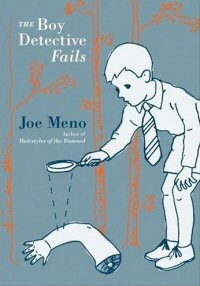 Remember Encyclopedia Brown? Well, let’s take Encyclopedia and bring him to adulthood. Our now-grown boy detective is named Billy Argo. Billy found his calling early in life, after being given a detective set as a birthday gift. Along with kid sister, Caroline as his right hand, and their neighbor, Fenton, along as sidekick, Billy and Co., consistently thwarted the surprisingly considerable criminal element of
 You Don't Love Me Yet by Jonathan Lethem
 More than anything, this book made me angry. Not the righteous indignation of believing in what the author has written about; this made me angry because Lethem is such a better writer than this flimsy little novel. Now I know I can’t expect everything he writes to be Motherless Brooklyn (Lionel Essrog—wherefore art thou, Essrog?) or Fortress of Solitude; that’s too much to ask and it would be unfair. The thing is, if this was a first or second novel by a promising 30 year old Iowa MFA who’d kicked around L.A. in a band for a while and wrote a story based on that, I’d say “Let’s see what this kid has in a couple of years”. My beef is that by the time he was 30, Lethem was already writing promising and highly original work like Gun With Occasional Music and went on to write other really great stuff. I’m completely bummed because I was so looking forward to reading new Lethem. This is more like Lethem-lite and that just won't do.
Babylon's Burning by Clinton Heylin
 I’m always a sucker for yet another history of punk rock but at 800+ pages, this is both exhaustive and exhausting. Written in the oral history style that made Legs McNeil’s Please Kill Me so entertaining and effective, Heylin can definitely tell the story in great detail. That’s also the problem--I found myself reading (and reading and reading) about bands he gives far too much credit and about whom I could care less. Once I allowed myself to skip the many, many passages about lesser bands like The Only Ones, The Prefects and Throbbing Gristle (honestly!), I was finally able to finish the damn thing. An ambitious and often informative book but perhaps the story has been told to death at this point.
The Dead Father's Club by Matt Haig
 This is a pretty clever re-telling of Hamlet through the eyes of an eleven year-old boy in a small English town. After Philip Noble’s father dies in a car accident, his father’s ghost appears to him to tell him that his uncle had him murdered and that if young Philip can’t avenge him, and he has only a short time to do so, he will suffer the Terrors for eternity. The beauty is putting these demands at the feet of a seemingly normal kid. Who’s going to believe him? Is this really happening? How do you kill an adult? Where do you even start? The book is being marketed to both adults and as a YA novel a la Mark Haddon’s Curious Incident of the Dog in the Nighttime so it’ll be interesting to see how this book does and who it reaches. A good read.
Thursday, November 02, 2006
Water For Elephants by Sara Gruen
 What a wonderful story. This is a truly engrossing page-turner that hits almost all the right notes and meticulously paints a picture of a time when the world was much larger. Just as he’s about to graduate from college and take his final exams to become a veterinarian, Jacob Jankowski loses his parents in a tragic car accident. Finding they had mortgaged absolutely everything to put him through school, he despondently hops a freight only to find it’s a circus train. The Greatest Show on Earth it ain’t. The Benzini Bros. Circus is as third rate as it comes but Jacob finds work as a much-needed vet. Gruen did a ton of research and it shows–her evocation of this Depression-era circus, the language of the time and how a circus functions, day to day and town to town, is remarkable. The characters that people the circus are memorable and she manages to humanize the minor characters--the roustabouts, dwarves and cooch dancers--as well as the main characters like Uncle Al, the sadistic ringmaster and boss; August, the psychotic head animal trainer and his wife, the circus’ star, Marlena, whom Jacob falls for immediately; even Rosie the elephant. The only disappointment was the ending, part of which I could see coming a mile away. Still I cried like the fool I am for stories like this. This is a must-read.
Not Enough Indians by Harry Shearer
 Yes, that Harry Shearer, of The Simpsons and Spinal Tap fame. Set in Gammage (rhymes with damage, I’m guessing), NY, Shearer’s debut novel begins when an idea is hatched by the local politicos to reinvigorate the financially depressed town by opening an Indian casino. The rub is that there are no Indians so they call in an “expert” who makes a specious claim that most of the residents are 1/16 Filaquonsett, a tribe that used to live in the area but were relocated to reservations by the US government a generation or two before. From here, Shearer lets his zany & madcap cast of characters run the show all the while trying to comment on greed, big business, and political correctness. It only works occasionally. The peculiarities and peccadilloes of the townsfolk are forced, the commentaries on modern day
 Tuesday, October 31, 2006
26A by Diana Evans
 Sad, sweet and somewhat haunting, Evans debut novel tells the story of twins, Georgia and Bessi who share a loft at 26A
 Thursday, October 19, 2006
Utterly Monkey by Nick Laird
 This is definitely being marketed as lad lit but it’s a cut above most lad lit in that it’s not the usual formula—dorky but likeable guy who can’t grow up and/or commit, surrounded by lovable but eccentric pals and the wackiness that ensues until dorky but likeable guy actually does grow up and/or commits. First off, Laird has a vocabulary that had me reaching for the dictionary and it wasn’t just one of those “I’ll really impress them if I use ‘crepuscular’ here instead of ‘twilight’” moves. Second, his main characters, old friends from Belfast, Danny and Geordie, aren’t the stock lad lit characters. They’re both a bit more thoughtful and in touch with themselves. Danny is living in London as a somewhat successful lawyer but hates his job. Geordie, who stayed in Belfast and hasn’t really done much with his life, shows up on Danny’s doorstep unannounced with a sack full of stolen money that is actually supposed to fund a terrorist action by Ulster loyalists. Cue ensuing wackiness! Throw in your inter-office, inter-racial love affair, chances to do right by “the people” by thwarting big business and a rather hurried ending and you have Utterly Monkey. Despite the Belfast connection, I found this reminiscent of Robert McLiam Wilson’s delightful Eureka Street (anyone have any idea what happened to Robert McLiam Wilson?) though not as clever or as laugh-out-loud funny. Still, Laird’s writing is strong and amusing and he tells a pretty engrossing tale.
Wednesday, September 27, 2006
Mixed Nuts: America's Love Affair with Comedy Teams from Burns and Allen to Belushi and Aykroyd by Lawrence J. Epstein
 Having really enjoyed The Haunted Smile, Epstein’s book on Jewish comedy in America
Wednesday, September 20, 2006
Grayson by Lynne Cox
 Lynne Cox is a world-renowned channel swimmer who has swum the
 Friday, September 15, 2006
Winkie by Clifford Chase
 Kudos, Grove publicity department; the effective pre-publication marketing of the book dragged me in. Fun premise--a forgotten teddy bear comes to life and is mistaken for a Unabomber-type and taken into custody by the government. This could have, should have been the biting Bush-era political satire it aspired to be (one that seems strangely absent from the bookstores). Until you actually read it. Then you find it such a sprawling mess, filled with such nonsense and loose ends, it's amazing it got published at all. I'd rather eat lint.
Wednesday, August 30, 2006
The World According to Mr. Rogers by Fred Rogers and I'm Proud Of You by Tim Madigan

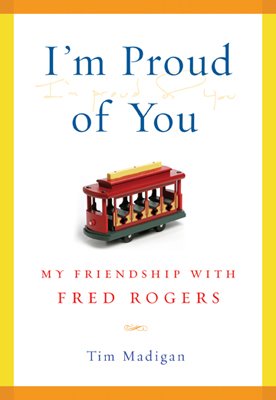
One winter quarter in college, I got depressed and the one thing that made me feel better was watching Mr. Roger’s Neighborhood, despite the fact that I was probably 20. It just felt warm and good and helped get me out of my funk. As a little kid growing up in
My Life In and Out of the Rough: The Truth Behind All That Bullshit You Think You Know About Me by John Daly
 Say what you will about Daly but this is a guy who knows who he is and won’t back down from that. What you get is Daly telling his own story, dispelling some of the myths, correcting some outright lies and shooting straight from the hip. He’s a golfer and a damn good one but he’s also got a gambling problem like you can’t believe, smokes and drinks far too much and knows he could fall off the wagon anytime. His refreshing honesty was what made the book readable. Daly’s no writer but there’s a story to tell and he’s not going to leave that to someone else. Like so much else in his life, he takes responsibility for himself and his actions (past, present and future) and that’s way more than can be said for many other “wild” public figures.
Sunday, August 27, 2006
Easter Rising by Michael Patrick MacDonald
 A few years back, McDonald wrote the brilliant All Souls, a painful memoir of growing up in the Old Colony housing projects in the Irish-mob controlled, white slums of South Boston and the many tragedies that befell his large Irish-Catholic family because of drugs, guns and the insulating ignorance of the community. This sort of picks up where he left off-- his family is struggling and he’s depressed so he finds the nascent Boston punk rock scene, fits in a little, grows up a little and then he goes to Ireland and everything is all wild Irish roses. (The Ireland trips reminded me of the tacked on “Communism-will-solve-all-your-problems” ending from Upton Sinclair’s The Jungle and was just as unsatisfying.) MacDonald certainly writes well enough but Easter Rising just isn’t All Souls. I’ve said it before—I’m suspect of people who write their memoirs before the age of forty and even moreso of those who then write a second or third, especially if you aren’t some notable public figure or have gone on to do remarkable things between books. As much as I admire the author, his story, and his skills, it just didn't involve me as I had hoped.
Monday, August 14, 2006
Complicated Shadows by Graeme Thompson
 Oh goody. Another Elvis Costello biography that is assembled from old newspaper and magazine pieces and interviews with everyone but the man himself. I've been down this road before how many times only to be left horribly unsatisfied by the books and turning to the back catalogue of CDs to let the music do the talking. Surprisingly, this one doesn't suck. (Take that Tony Clayton-Lea! And that! David Gouldstone, you moping, misogynistic hack!) It was informative (well, it is a biography), fairly insightful, and well-paced. I suppose I'll never be fully satisfied until we hear the whole story from Elvoid's own lips, but this is perhaps the best of the many clip jobs published over the years.
Clemente: The Passion and Grace of Baseball’s Last Hero by David Marannis
 Greg Coates was my neighbor when I was a kid. He wasn’t a baseball fan at all (though he counted a lenticular Pete Rose baseball card he got from of a box of Kellogg’s Corn Flakes among his prized possessions--go figure), but I will never forget the New Year’s Day, 1973, when he knocked on my door and told me Roberto Clemente had been killed in a plane crash. Clemente had been among my first heroes and now he became my first martyr. Marannis gives Clemente’s life the Gold Glove treatment. He neither paints Roberto as a saint (though in many ways, he was) nor as a tragic hero (he was) but as a man who was far more complex than he was given credit in his day. In 18 years with the same team, he had 16 Gold Gloves, 4 batting championships, a lifetime .326 batting average and achieved 3000 hits in his very last at bat despite being continually labeled a malingerer and a hypochondriac throughout his career. He was the epitome of power, speed, grace (except when running to first) and hustle and Marannis does a wonderful job telling a very complete story.

Subscribe to:
Posts (Atom)